
A paid claim answers one question: did a payment arrive? It does not, by itself, answer the question a physician owner needs to ask next: did the practice receive the amount the applicable agreement required?
That distinction matters when collections look reasonably steady. A small reimbursement difference can be difficult to recognize inside an overall payment total, particularly when the practice relies on several reports to explain what happened. The starting point is a consistent comparison between the payment expected for a service and the payment actually received, supported by the records needed to explain the difference.
Start with an expectation you can support
Before labeling a payment as an underpayment, establish which agreement and fee schedule applied to the claim. The relevant version is the one applicable to the service and its date, provider, location and plan. A current contract file is useful, but it may not explain an older claim or a payment governed by a different product.
Build the review around the contract and applicable amendments, the claim detail, the remittance advice and the payment posting. Include the service code, modifiers, units, dates and any other information needed to understand the reimbursement calculation. If a required record is missing, label the expectation as unverified and identify who can obtain it.
The AAFP recommends keeping fee and reimbursement schedules available to establish expected payment and reduce inappropriate write-offs. Its guidance also warns that mixing contractual and noncontractual adjustments can distort collection performance. See the AAFP's practice-finance guidance.
Separate the allowed amount from the payer's share
Consider a simplified fictional claim with an expected allowed amount of $200. If the remittance assigns $40 to patient responsibility and the payer pays the remaining $160, the $40 difference between the allowed amount and the payer's payment is not automatically a payer underpayment. The reviewer must establish whether the allocation and payment are correct for that claim.
For the same reason, a comparison should account for applicable adjustments, other payments, reversals and corrections before reporting a discrepancy. Comparing billed charges directly with a payer payment does not establish that the contract was violated. The comparison needs to use equivalent amounts on both sides.
Make the finding specific enough to investigate
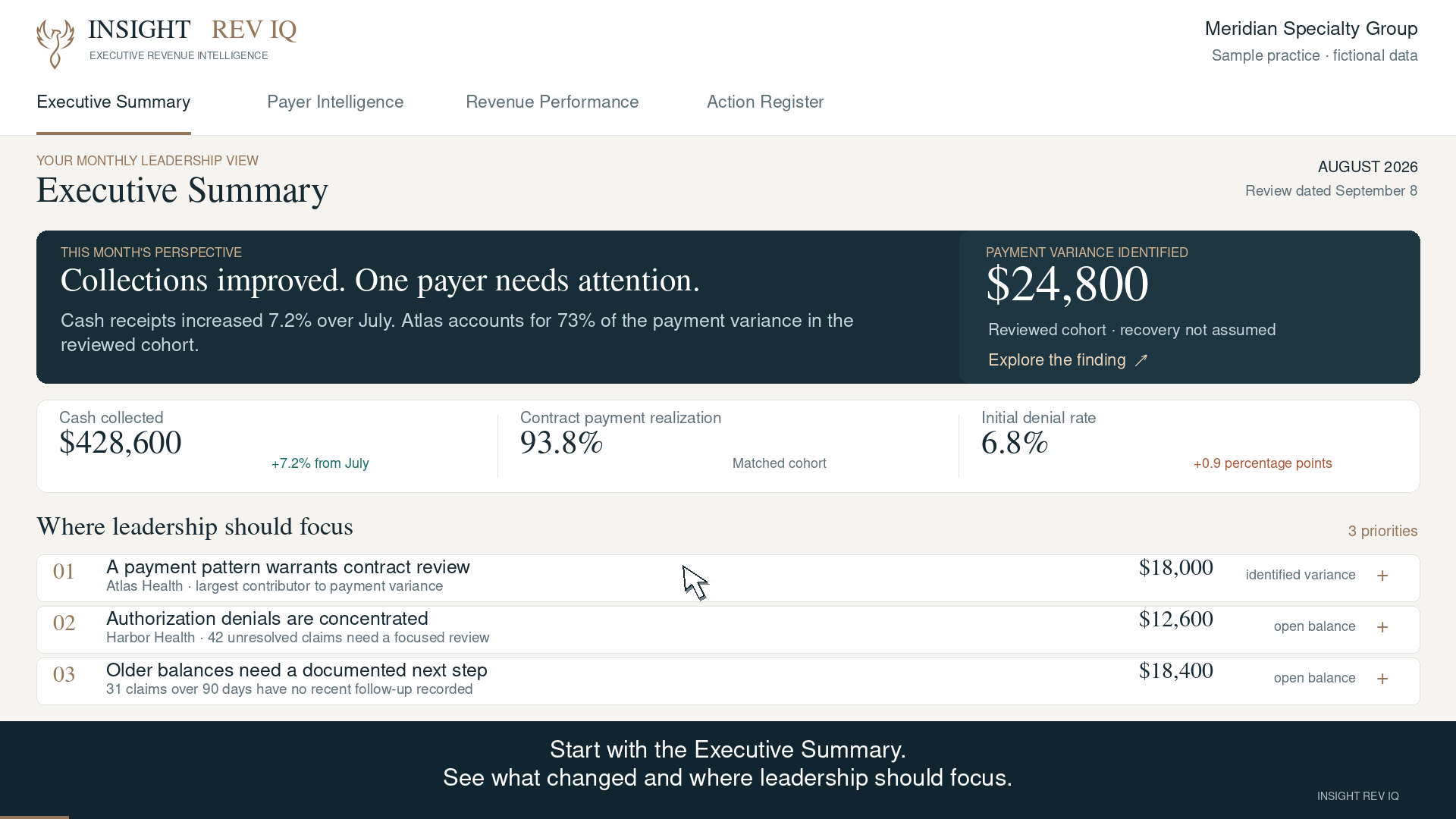
In the fictional Meridian Specialty Group dashboard, 400 matched claims show $400,000 in expected payer reimbursement and $375,200 in payer payments, a potential variance of $24,800. Atlas accounts for $18,000 of that difference across 120 claims. These figures are illustrative and are not a client result or a recovery estimate.
The executive value is the ability to move from a practice-level signal into the payer and claims that explain it. Leadership can ask for the applicable agreement, confirm the payment-matching method and identify whether the apparent difference is concentrated in particular services or circumstances.
At this stage, the finding remains a potential variance. A validated underpayment requires evidence that the payment fell short of the supported expectation. A recovery is a later event that must be confirmed through payment and reconciliation. Keeping these stages separate makes the report more useful for decisions.
Give the next step an owner
A useful action entry identifies the finding, the evidence still needed, the person responsible and the next review date. For the fictional Atlas finding, the contracting lead could confirm the applicable fee schedule while the billing lead reconciles remittance and posting detail. The practice manager can then bring the results back to the leadership review with a recommendation for the appropriate follow-up.
Priority should reflect more than the largest apparent dollar amount. Consider the reliability of the evidence, whether the issue is recurring, the effort required to resolve uncertainty and any applicable time limits that the responsible team needs to check. Avoid adding overlapping findings together as if they represent separate financial opportunities.
Monitor what happens after the review
Once an issue has been evaluated, the next monthly review should establish what changed. Was the variance explained? Did the responsible team obtain the missing records? Are newer payments showing the same pattern? If corrective action was taken, is there evidence that subsequent performance improved?
Insight Rev IQ provides Executive Revenue Intelligence that connects these questions with payer scorecards, leadership priorities and an action register. Our role is to identify and prioritize findings, equip the practice and its advisors with evidence, and guide follow-up with the responsible team.
Watch the narrated sample dashboard walkthrough to see how a finding moves into an executive decision. If your practice needs a starting point, begin the brief Revenue Performance Insight Review to identify questions that may warrant deeper analysis.
Continue with the monthly revenue scorecard for physician owners, or explore the Knowledge Center.
-min.webp)


.svg)
